
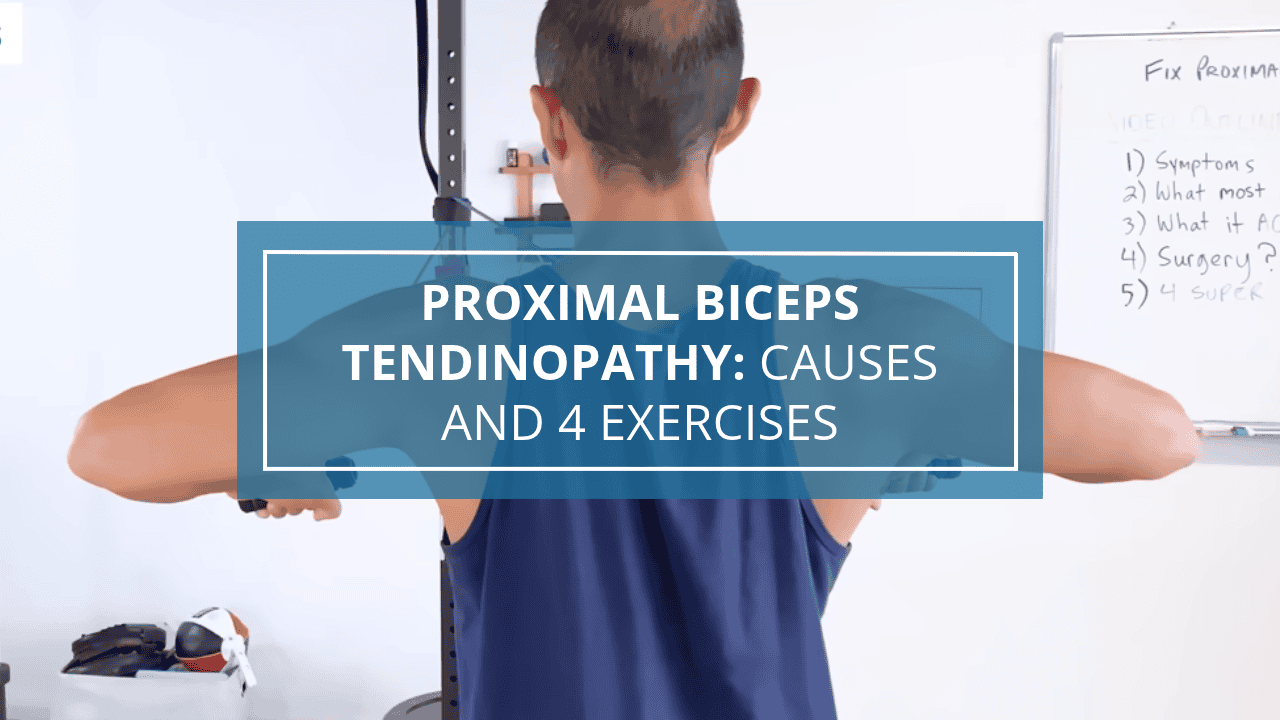
Proximal biceps tendinopathy can cause pain when you lift your arm overhead, reach for something on a high shelf, or try to sleep on your side. If you’ve been focusing on the biceps muscle itself with stretching, massage, or other treatments, you may be missing an important part of the problem.
The biceps tendon is often where you feel the pain, but that doesn’t necessarily mean the biceps is the root cause.
In this article, I’ll explain what proximal biceps tendinopathy is, what can contribute to it, and four exercises you can do at home to address those contributing factors.
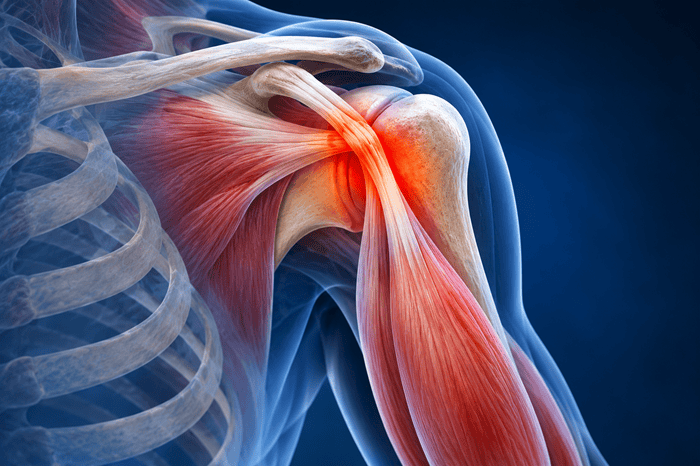
Biceps Tendonitis vs Tendinopathy
The biceps muscle attaches to bone near the shoulder through a tendon. Proximal biceps tendinopathy refers to a problem in that tendon, close to where the biceps attaches near the shoulder.
You may also hear the term biceps tendonitis. There’s a distinction between the two:
- Tendonitis refers to the acute phase, when there’s inflammation and pain but the problem hasn’t become chronic.
- Tendinopathy refers to a longer-standing problem where the pain has been around for a long time and the tendon starts to deteriorate.
If you’ve been told you have tendinopathy, you’re dealing with a chronic pain stage.
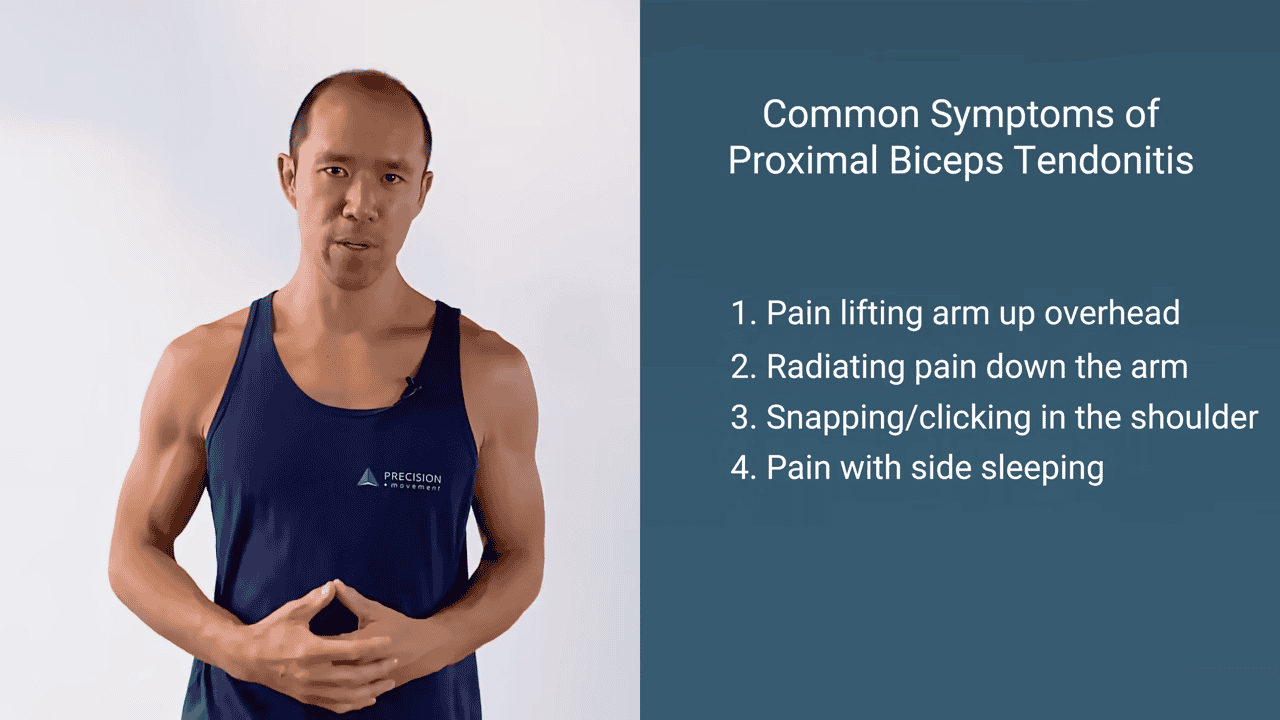
Common Symptoms
One of the most common symptoms is pain when lifting your arm overhead. This might happen when you’re playing a sport or simply reaching for something in a high cupboard.
Other symptoms can include:
- Pain that radiates down the arm.
- Snapping or clicking of the tendon around the groove in the humerus (the upper arm bone).
- Problems sleeping on your side. Side sleeping can aggravate the symptoms and contribute to a vicious cycle of discomfort and poor sleep.
What Causes Proximal Biceps Tendinopathy?
A common misconception is that the biceps muscle itself is the problem. People may assume the muscle is too weak, too tight, or has scar tissue that needs to be worked on.
A biceps-focused approach might involve stretching, massage, ultrasound, or shockwave therapy. Those are common treatments when the focus is on the biceps.
However, biceps tendinopathy is a symptom. It isn’t necessarily the root cause.
What Research Tells Us
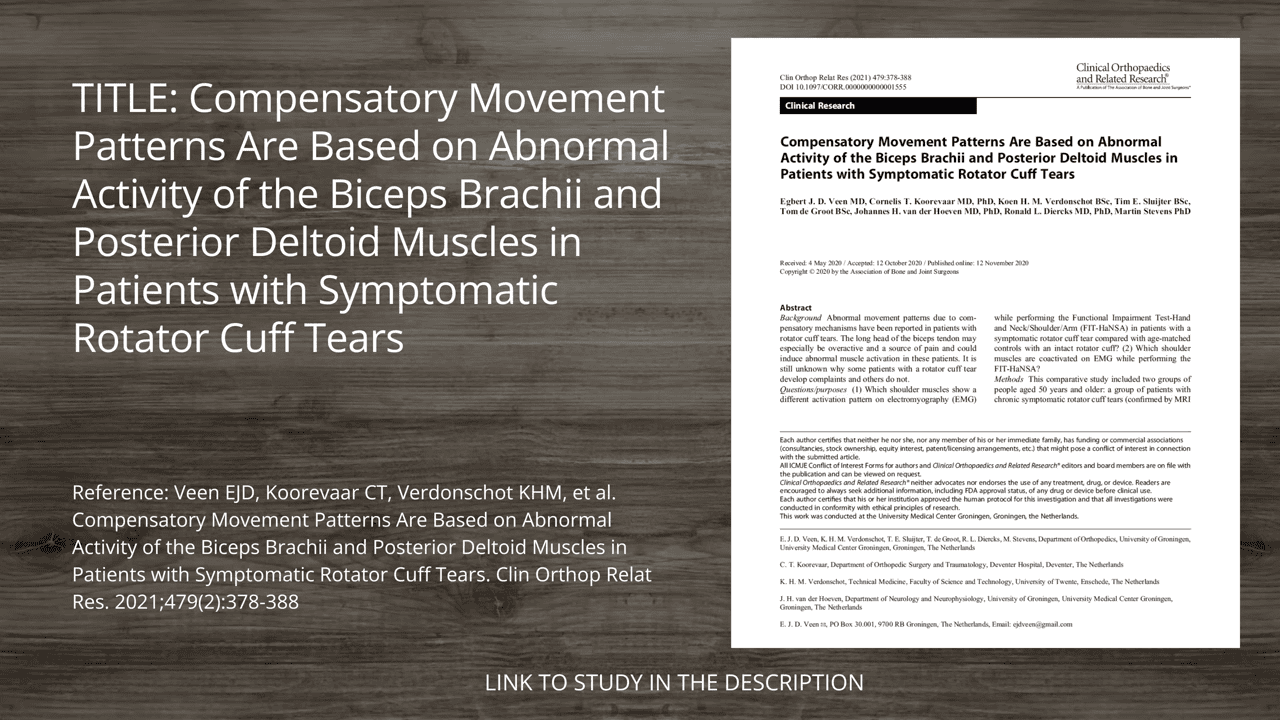
A study titled Compensatory Movement Patterns Are Based on Abnormal Activity of the Biceps Brachii and Posterior Deltoid Muscles in Patients with Symptomatic Rotator Cuff Tears gives us a hint about what’s happening. [1]
When somebody has a rotator cuff tear, those muscles are weaker than they would be without the tear. Something else has to pick up the slack.
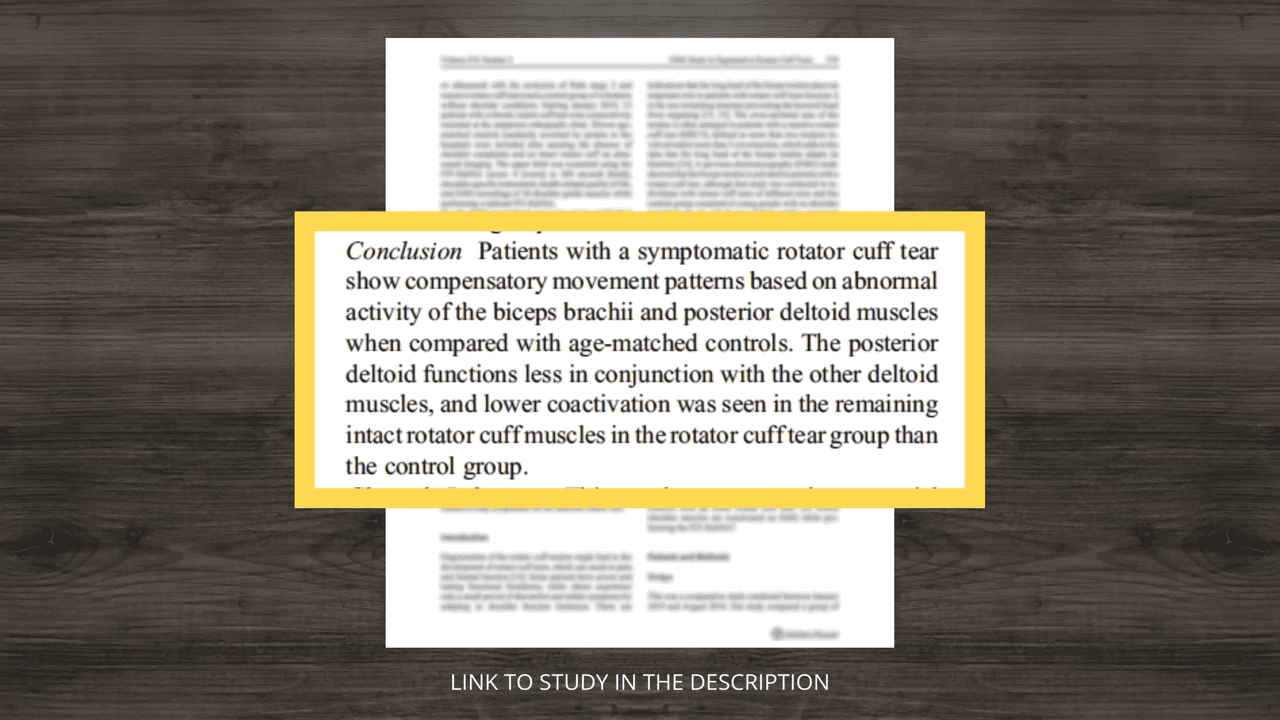
In the study, researchers used EMG to examine muscle activity. They found hyperactivity in the posterior deltoid and biceps brachii during the upward phase of arm movement in patients with rotator cuff tears, compared with people without a tear. The authors concluded that patients with symptomatic rotator cuff tears show compensatory movement patterns based on abnormal activity of the biceps brachii and posterior deltoid muscles.
From that study, it’s clear that the main problem is the biceps is overworking and compensating for something else that’s not working properly.
That something else could be the rotator cuff, as it was in the study. But other things can also cause the rotator cuff not to work and do its job properly.
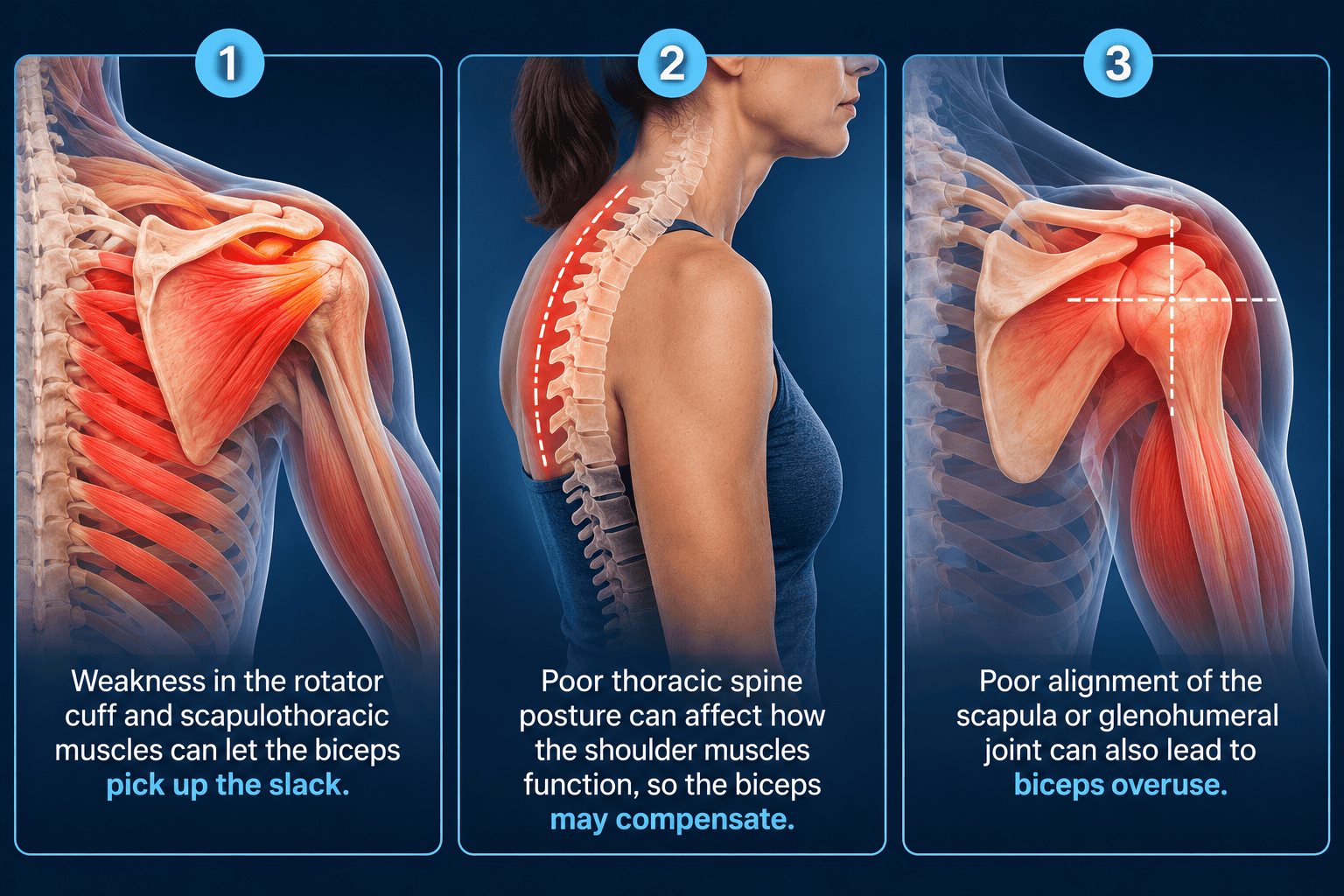
Three Main Shoulder Issues
1. Weakness in the rotator cuff and scapulothoracic muscles
The rotator cuff muscles help stabilize the shoulder joint. The muscles that control the scapulothoracic joint help connect and control the shoulder blade in relation to the thoracic spine.
Weakness in these muscle groups can affect how the shoulder works. This includes muscles such as the serratus anterior and rhomboids, which help control the shoulder blade.
When these muscles aren’t doing their job properly, the biceps can pick up the slack when you move your arm.
2. Poor thoracic spine posture
Your thoracic spine is the middle portion of your back. When your posture in this area is poor, the muscles that stabilize the glenohumeral joint (the shoulder joint) and the scapulothoracic joint (the connection between the shoulder blade and thoracic spine) can’t function optimally.
Something else has to pick up the slack when you move your arm, especially overhead. That can be the biceps.
3. Poor alignment of the scapula or glenohumeral joint
Even if your thoracic spine posture is good, poor alignment of the shoulder blade or glenohumeral joint can still affect how the shoulder muscles work.
If the shoulder is sitting in a poor position, the rotator cuff and scapulothoracic muscles can’t work optimally. The biceps may compensate to pick up the slack, and eventually it can wear out.
Does Surgery Address the Root Cause?
There are two main types of surgery for the proximal biceps tendon.
In one type, the surgeon cuts the biceps tendon away from the bone and lets it hang, with the hope that it heals properly.
In the other, the surgeon cuts the tendon and then reattaches it using staples, screws, or sutures.
But think about the root causes. If the problem is poor thoracic spine posture, is cutting the tendon and reattaching it going to help? What if the problem is weak rotator cuff muscles?
The answer is no.
That’s why surgeries of this type often fail months or years after you get them.
4 Exercises for Proximal Biceps Tendinopathy
The solution is to address the contributing factors through exercise. That means restoring good alignment and posture, strengthening the muscles, and recreating proper movement patterns so you’re using the right muscles when you move.
Here are four exercises to work on those areas.
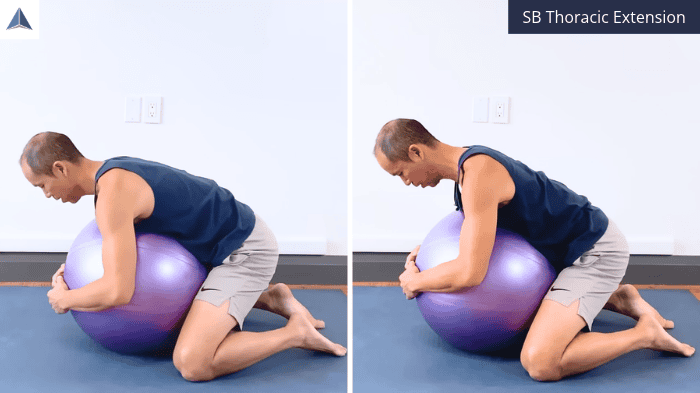
1. SB Thoracic Extension
This exercise helps activate the deep muscles around the thoracic spine called the multifidus. These muscles are important for maintaining good posture. Simply trying to stand up straight and pull your shoulders back into a military posture isn’t a practical solution, because you won’t be able to hold that position all day.
- Lie face down with your stomach on a stability ball and your legs positioned underneath it.
- Push your pelvis into the ball to round your lumbar spine and tilt your pelvis backward.
- Relax over the ball with your hands on it, and look up and forward.
- Lift your chest off the ball while looking down toward it. Lengthen your neck as if a string is gently pulling your head forward.
- Keep everything from your thoracic spine down rounded and flexed to isolate the movement in the thoracic spine.
- Hold the position and breathe naturally, then lower your chest and relax.
Don’t squeeze your shoulder blades together to activate the rhomboids. The goal is to isolate the multifidus muscles around the thoracic spine.
Sets and reps: 2 sets of 3–5 reps, holding each rep for 10 seconds.
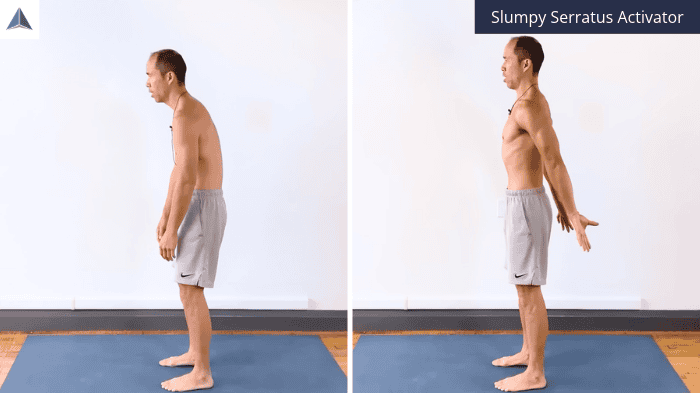
2. Slumpy Serratus Activator
This exercise works the serratus anterior while also getting the lower trapezius and rhomboids to co-contract. It teaches you to move out of a slumped position and helps integrate good posture and shoulder-blade positioning into your nervous system.
- Start in a slumped posture, with your head forward.
- Slowly straighten up as you reach your arms behind you and internally rotate your shoulders.
- Pull your shoulder blades together and tilt them backward, drawing the bottom edges toward your rib cage.
- Get tall and roll your shoulders back. Lift your hands away from the ground while maintaining the position.
- Keep your shoulders down and away from your ears.
- Maintain the muscle tension as you return your hands to neutral, then gradually release while keeping your good posture.
Sets and reps: 2–3 sets of 4–6 reps, holding each rep for about 10 seconds.
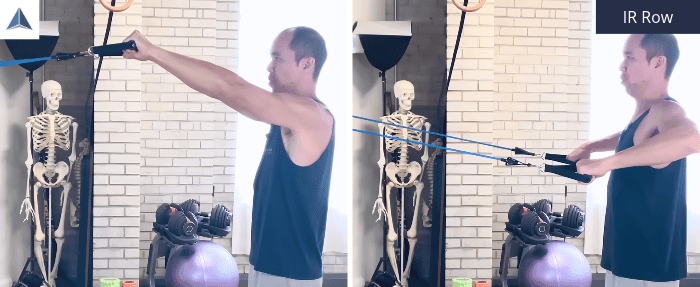
3. Internal Rotation Row (IR Row)
This exercise targets the subscapularis, one of the rotator cuff muscles and the only one that performs internal rotation. The subscapularis can be under-recruited and weak because stronger internal rotators, such as the pecs and lats, often take over. You want the subscapularis contributing to the overall stability of the shoulder joint during movements such as rows and pushes.
- Anchor a resistance band around face level.
- Keep your wrists straight and neutral throughout the exercise.
- Start with your hands in line with the band and your face, then lift them slightly above that level.
- Row with your elbows out wide, bringing your hands below the level of your elbows.
- Reverse the movement and return to the starting position.
- Focus on pinching your shoulder blades together, keeping your shoulders down, and moving slowly.
- Use light resistance. The goal is good muscle activation, not a heavy band.
Sets and reps: 2–3 sets of 8–12 reps.
4. Four-Point ER Row
This exercise targets the external rotators of the shoulder and overall shoulder stability. You’ll start on your hands and knees, then progress to a push-up position if you want to build more strength and you’re no longer in the acute phase.
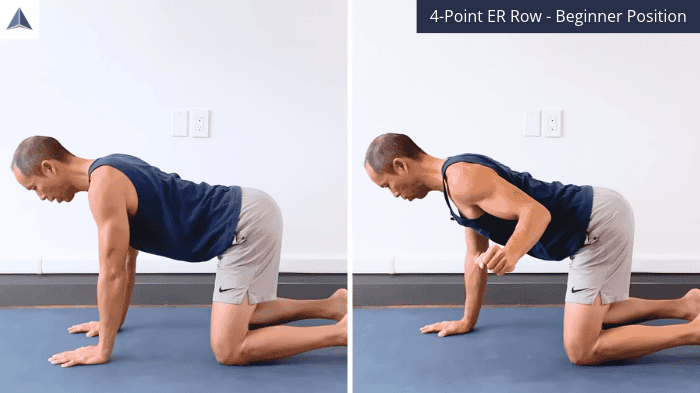
Beginner Version: 4-Point Position
- Start on your hands and knees.
- Keep a natural curve in your lower back, tuck your chin, and lengthen your neck.
- Keep your shoulder blades in a neutral position—not fully pinched together or pushed apart—and keep your shoulders down away from your ears.
- Lift the affected arm off the floor and perform a row with your elbow tucked close to your side, adding external rotation. Hold for 5 seconds, then lower.
- Repeat with your elbow out to the side, rowing and externally rotating. Hold for 5 seconds, then return.
- Alternate between the elbow-tucked and elbow-out positions. One rep is one of each.
- Keep your spine still. The only movement should come from your arm.
- Perform the exercise on both sides for balance.
The elbow-tucked position targets the teres minor, while the elbow-out position targets more of the infraspinatus.
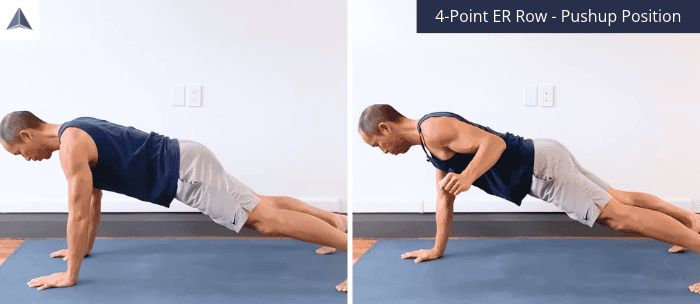
Progression: Push-up Position
If you want to build more strength and you’re not in the acute phase, you can progress to the push-up position. Coach E suggests trying this perhaps two to four weeks after working with the four-point version.
- Set up in a push-up position with good alignment. You may need to spread your feet a little wider.
- Perform the row with your elbow tucked and add external rotation. Hold for 5 seconds, then return.
- Perform the row with your elbow out and add external rotation. Hold for 5 seconds, then return.
This version places a greater demand on shoulder and core stability. It also trains anti-rotational stability through the core, which is useful for everyone and especially for athletes in sports such as baseball, hockey, and tennis, where rotation is involved.
Sets and reps: 2–3 sets of 3–5 reps per side, holding each rep for 5 seconds. Each rep includes both elbow positions.
Your Proximal Biceps Tendinopathy Exercise Routine
Here’s a quick recap of the routine:
| Exercise | Sets | Reps | Hold |
|---|---|---|---|
| SB Thoracic Extension | 2 | 3–5 | 10 sec |
| Slumpy Serratus Activator | 2–3 | 4–6 | 10 sec |
| Internal Rotation Row | 2–3 | 8–12 | — |
| Four-Point ER Row | 2–3 | 3–5 per side | 5 sec |
Do this routine 2–3 times per week for at least 4 weeks and up to 6 weeks. You’ll find great relief in your proximal biceps tendinopathy.
These four exercises address the common contributing factors we’ve discussed: posture, shoulder alignment, and the muscles that help stabilize and control the shoulder.
Give the routine a try. I’m guessing you’ll find some relief from it. And if you want to take it further, follow the Shoulder Pain Solution program in our ROM Coach app.
For more exercises, check out these related articles:
Key Takeaways
-
Proximal biceps tendinopathy may be a symptom of underlying shoulder dysfunction rather than an isolated problem with the biceps tendon.
-
Weak rotator cuff and scapular stabilizer muscles can affect shoulder stability and cause the biceps to compensate during arm movements.
-
Poor thoracic spine posture and improper shoulder blade or joint alignment can interfere with normal shoulder mechanics.
-
Effective rehabilitation should address the contributing factors by improving posture, restoring shoulder alignment, and strengthening the muscles that stabilize and control the shoulder.
-
These four exercises target thoracic spine activation, serratus anterior function, subscapularis strength, and shoulder stability.
-
Perform the routine 2–3 times per week for 4–6 weeks to work on improving shoulder mechanics and reducing symptoms.