


Don’t just accept that office life means a constantly achy back. Learn to keep your spine healthy with these simple spine care exercises you can do at your desk.
Welcome back to my Active Office Worker series. In this fifth installment, we’ll be focusing on the most common issue for desk workers – low back pain.
Why Desk Work is Tied to Low Back Pain
Why is sitting at a desk such a huge issue for people? I mean, you’re just sitting there, right?
Research has found that time spent sitting and low back pain go hand in hand [1].
If you’re sitting in a chair all day, your body doesn’t need to do much to support you. Your body will go into energy saving mode and your abdominal muscles and deep spinal stabilizer muscles will shut off and let the chair and the backrest do the work.

Over time, these muscles become weak and your thoracic (or mid-upper back) and lumbar spine (low back) lose their internal support.
And this is often when low back pain can start to set in, because at some point, you have to move and because these muscles have become deconditioned, they aren’t able to give you the support you need, when you need it.
Then, the connective tissues like the ligaments and discs absorb more of the forces that would have gone through the muscles, had they been capable of doing their job.
That’s why it’s important to keep these (and all) muscles strong.
However, one aspect of the spine that often gets lost is that it’s equally important to work on spinal mobility.
In fitness, it’s popular to think of the spine as a single unit, which is to keep it and train it in neutral all the time.
But consider that your spine is made up of 33 vertebrae stacked on top of each other and while the bottom 9 are fused – the sacrum and coccyx – meaning no movement can occur there, the remaining 24 that comprise the lumbar, thoracic and cervical spine move in all three planes of motion: sagittal (flexion/extension), frontal (side bending) and transverse (rotation).

Image by www.goodmancampbell.com
When your spinal muscles atrophy due to the “use it or lose it” phenomenon, they can no longer properly control all of these spinal joints and you lose what is referred to as segmental control.
Then, when you are required to move your spine, some of these joints can become stuck, which causes a compensation at other joints where they are required to move more than they should, which creates a hinge point.
At the hinge point, the connective tissues are taken to extreme ranges resulting in excess stress going through them and over time, damage.
That’s why it’s just as important to train mobility and segmental control of the spine as it is core stability. The key is to first train core stability to allow any damaged tissues to heal, then move to developing segmental control and mobility so the spine becomes resilient.
I break down this whole process into 3 phases with assessments outlining how long to spend in each phase with every exercise and rep prescribed in my Spine Control course and the simple exercises I’ve got for you here today are a great place to get a taste of this approach.
Spine Care Exercises for the Office
Anterior Torso ISO: 3-6 x 10s per
This first technique will help activate your anterior abdominal wall and get your rectus abdominis (or 6-pack muscle) to wake up and start pulling its weight. This move is an isometric hold – meaning you are activating the muscle, but not making any big movements.

- Sit up tall and with a neutral spine
- Squeeze and activate your abs as you stay sitting up tall – don’t let your torso flex forward
- Place your hands on your thighs and think about driving your torso forward with your abs as you press your hands down
- Breathe as you stay active for 10 seconds. Release and complete 1-6 reps
Lateral Torso ISO: 3-6 x 10s per
The second low back pain exercise will activate your lateral torso muscles like your quadratus lumborum, latissimus dorsi, and internal and external obliques. It’s important to work the entire 360° of your core – not just that 6 pack.
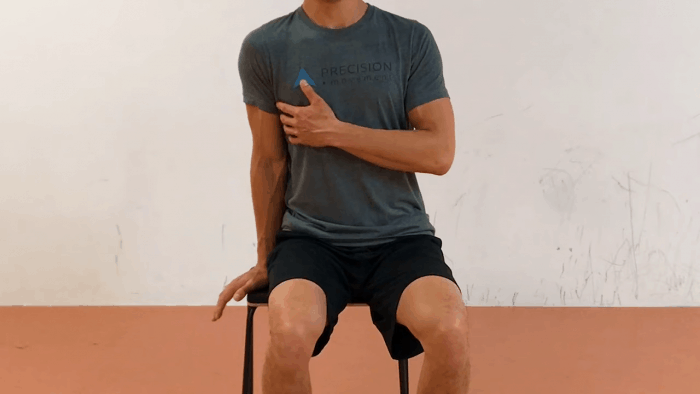
- Slide over to the right edge of your chair so you can place your left hand on the side of the chair
- Contract your abdominal muscles as you think about side bending into your left hand – like you were going to reach for something on the floor by your left ankle
- Hold and stay active as you breathe for 10 seconds
- Release and repeat 1-6 reps then repeat on the other side
Segmental Spine Flexion & Extension: 2-5 reps
The third move will help you create and control segmental movement in the cervical, thoracic, and lumbar spine. This will help keep those individual vertebral joints moving and functioning healthily. Plus, it’ll give you a momentary break from the computer work for some nice back and neck stretches.
This exercise will likely be tough at first, and you may feel like a whole section of your spine is moving at once. That’s normal. Stick with it and you’ll start to build movement and control at individual segments.

- Sit up tall and then extend the spine – pushing your chest up toward the ceiling
- Start to flex through the cervical spine – SLOWLY taking chin towards your chest and trying to round forward vertebrae by vertebrae as you maintain extension in the thoracic and lumbar spine
- Continue to flex through the thoracic and lumbar spine
- When you are completely flexed forward, start to extend one vertebrae at a time, lumbar up to cervical region, keeping your chin flexed forward until the very end. Complete 1-5 reps.
Pelvic Tilts: 5-10
Last but not least are pelvic tilts. This is a great move for activating the trunk muscles that control the pelvis and building some blood flow down through the hips.

- Sit up tall and hold on to the sides of your chair behind you if needed
- Move into a posterior pelvic tilt by flexing your lumbar spine
- Next move into an anterior pelvic tilt, extending through the lumbar spine
- Try to stay stationary in the thoracic and cervical spine as you complete 5 reps
Incorporating these low back pain exercises into your daily work routine will help keep your spine mobile and healthier and help counteract all that sitting.
If back pain is disrupting your ability to get stuff done or hit the gym, OR if you are having a really hard time with segmental movement of your spine, you should check out my Spine Control program.
I created it to help you train your spine for long-term health and movement and like I said, it’s broken up into distinct phases so you first build neutral spine core stability then progress to spinal movement, which I term the dynamic control exercises.
Check it out if you want to follow a step-by-step process to restore segmental control and build a spine that’s resilient and resistant to injury.