
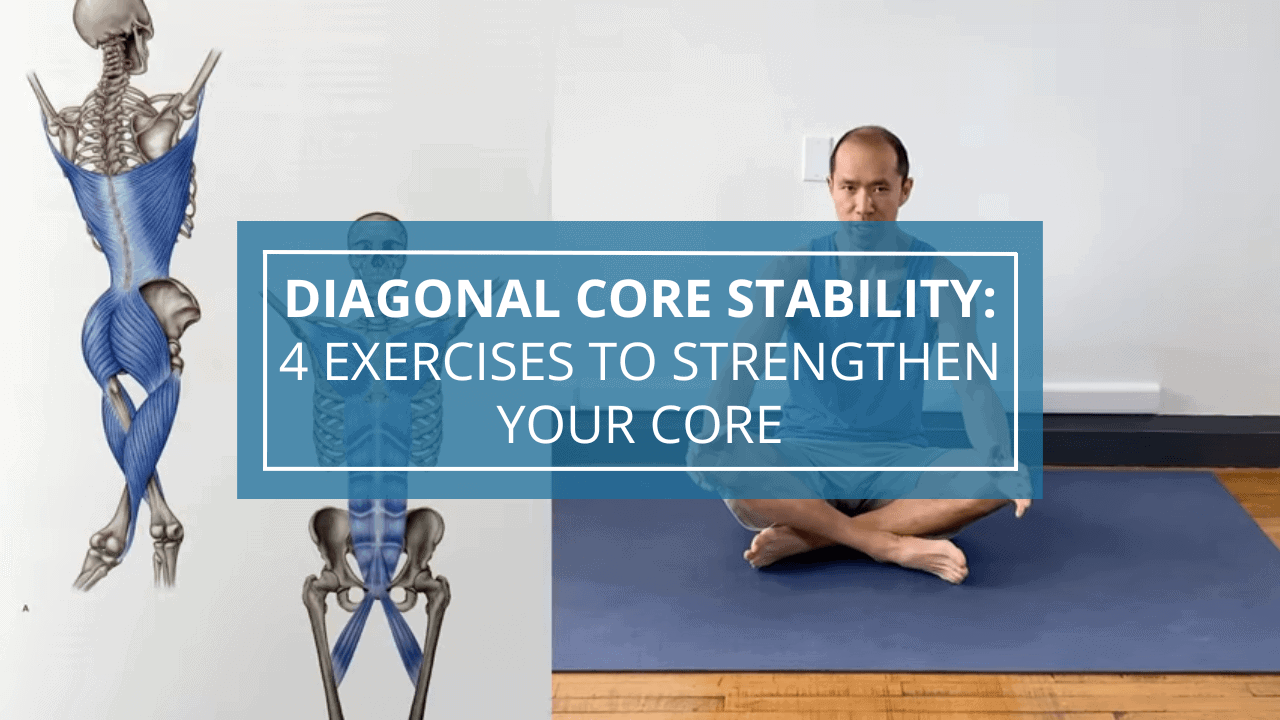
If you want to improve sport performance or just build functional strength and a resilient body, I want to show you four exercises I love to use. These exercises work what I call the diagonal stabilization pattern – both in the front and back of the body – and they’re challenging and fun.
Tom Myers, in Anatomy Trains, calls these the diagonal lines, and they’re everywhere: swinging a tennis racket, chopping wood, or even walking efficiently. [1]
But a lot of people go passive along these lines – the muscles don’t fire, and the joints end up carrying the load.
That’s what these four exercises fix. They teach your body to activate the core along these diagonal lines, improve functional strength, and build a resilient, well-coordinated core.
Why These Diagonal Patterns Matter
Here’s the deal: when your core stabilizers aren’t firing properly, your body compensates. Some muscles take over while others stay passive, creating weak spots along the diagonal lines. If certain segments hang off ligaments or tendons, your power transfer suffers, and your body becomes more prone to injury.
This is why so many traditional exercises leave gaps. Specific points along the line can be passive where the muscles aren’t active, and you’re just hanging off of it. By targeting these diagonal lines directly, we can activate the muscles we actually need, stabilizing the hips, shoulders, and spine in functional patterns.
How to Fix the Root Cause with Targeted Exercises
The solution is simple: I combine stability exercises with dynamic diagonal movements. I start by waking up dormant muscles with exercises that don’t move too much (stability), then I layer in movements like the Wood Chop and One-Arm Low Row to teach the body to work through the diagonal lines dynamically.
This approach ensures that every segment along the diagonal line is active, so we don’t rely on passive structures. These exercises build core activation patterns that transfer to sport, functional movement, and everyday life.
Once you’ve got these diagonal patterns firing, you can further improve rotational strength and hip-core coordination with these core and hip rotation exercises.
Superman Plank (Front Diagonal Line)
This exercise targets the front diagonal line from the hip to the opposite shoulder. It’s a great starting point for waking up muscles that are often underactive.

- Start in a push-up position, slightly wider than shoulder-width for hands and feet.
- Pull the chin in, activate shoulder blades, and avoid hiking shoulders into your ears.
- Lift one foot a few inches off the ground.
- Without shifting your body weight, lift the opposite arm to ~45° and hold for 5 seconds while breathing naturally.
- Lower under control and switch sides.
- Repeat 2–3 sets of 2–3 reps per side.
Key cues:
- Don’t let your body shift toward the lifted arm.
- Keep a neutral spine.
- Adjust hand/foot width if necessary to maintain stability.
Benefits:
- Activates front diagonal line for diagonal core stability.
- Strengthens glutes, lower traps, and shoulders.
- Teaches proper core activation patterns for movement and sport.
- Prepares your body for more dynamic diagonal stabilization exercises.
While you’re working on the front diagonal line, these forward head posture exercises can help you maintain proper neck and shoulder alignment.
Stability Ball Lateral Roll (Back Diagonal Line)
This works the back diagonal line, connecting the glutes to the opposite shoulder. It’s excellent for lateral core stability and reinforcing diagonal activation.

- Sit on a stability ball, roll down so your shoulders and head are supported, and keep hips elevated.
- Step laterally to one side without rotating or letting the pelvis drop.
- Hold for 5 seconds, keeping core tight and head tucked.
- Step out to the opposite side under control.
- Repeat 2–3 sets of 2–3 reps per side.
Key cues:
- Keep pelvis level; don’t let it sag.
- Walk your whole body laterally, not just your feet.
- Breathe naturally; don’t hold your breath.
Benefits:
- Engages glutes, obliques, and spinal stabilizers.
- Improves diagonal core stability and postural control.
- Strengthens core activation patterns for functional movement.
- Prepares body for dynamic diagonal patterns in sports or daily activity.
To further strengthen your lateral core and support your back diagonal line, check out these Quadratus Lumborum exercises.
Wood Chop (Dynamic Core Training)
This exercise strengthens the front diagonal line dynamically, integrating lower-body initiation with upper-body power.

- Anchor a resistance band or cable at the lowest height possible.
- Wide stance, knees bent, feet forward.
- Place far hand on the handle (the hand farthest from the cable).
- Initiate the movement by pushing off your leg first, transferring force through your hips.
- Pull the cable across your body to shoulder height with your far arm.
- Return under control.
- Repeat 6–8 reps per side, 2–3 sets.
Key cues:
- Initiate movement with lower body to engage full kinetic chain.
- Keep head level; maintain upright posture.
- Avoid letting muscles hang passively; activate along the diagonal line.
Benefits:
- Strengthens obliques, hip flexors, and shoulders.
- Enhances core activation patterns and force transfer.
- Builds functional strength training along the diagonal lines.
- Reinforces posture during rotational movement.
One-Arm Low Row (Back Diagonal Strength)
This targets the back diagonal line, emphasizing glute and hip activation while maintaining spinal stability.

- Anchor cable low; left hand grips handle, right foot forward, foot flat.
- Lean slightly at hips, spine straight, shoulders down.
- Row the handle, keeping the head centered on the anchor.
- Avoid driving hips forward; engage glutes and hip stabilizers.
- Repeat 6–8 reps per side, 2–3 sets.
Key cues:
- Maintain neutral hip and spine alignment.
- Keep foot flat, thigh pointing straight ahead.
- Focus on glute activation along the diagonal line, not just pulling with arms.
Benefits:
- Strengthens glutes, lats, and posterior chain.
- Improves diagonal core stability and functional strength.
- Teaches core activation patterns for rotational movements.
- Prevents passive tissue loading along the diagonal line.
Why These Exercises Actually Work
The magic is in combining stability and dynamic exercises:
- Superman Plank & Stability Ball Lateral Roll: wake up dormant muscles, reinforce neutral posture.
- Wood Chop & One-Arm Low Row: integrate lower- and upper-body force along the diagonal lines.
When we hang out passively on tissues, we get tissue creep – tissues get weaker instead of stronger. Activating the full diagonal line creates resilient, coordinated movement patterns that improve performance and reduce weak links.
Routine Summary
| Exercise | Sets | Reps | Hold | Notes |
|---|---|---|---|---|
| Superman Plank | 2–3 | 2–3 per side | 5 sec | Keep neutral spine; avoid weight shift |
| Stability Ball Lateral Roll | 2–3 | 2–3 per side | 5 sec | Keep pelvis level; walk whole body laterally |
| Wood Chop | 2–3 | 6–8 per side | N/A | Initiate from legs; pull cable across diagonal line |
| One-Arm Low Row | 2–3 | 6–8 per side | N/A | Keep hip neutral; engage glutes and lats |
Frequency: 2–3 times/week for 4–6 weeks
Goal: Build diagonal core stability, functional strength, and resilient movement patterns.
What to do next?
If you want a complete program to build strength, resilience, and performance with unique, science-based exercises like these, check out the Strong for Life program inside the ROM Coach app.
This structured program guides you through routines that strengthen your diagonal core stability and teach core activation patterns for everyday life and sport.
Key Takeaways
- Diagonal lines connect opposite hips and shoulders; essential for diagonal core stability.
- Passive muscles reduce functional strength and power transfer.
- Start with stability exercises, then layer dynamic diagonal patterns for full activation.
- Focus on active muscles, neutral spine, and controlled movement.
- Routine: Superman Plank → Stability Ball Lateral Roll → Wood Chop → One-Arm Low Row, 2–3x/week.
- Upgrade to Strong for Life in ROM Coach for guided progress.