
Do your shoulders get sore, irritated, or even painful when you try a plank or side plank? You’re not alone – this is one of the most common complaints I hear from people trying to strengthen their core.
You might think it’s just part of the workout, but front or side shoulder pain during planks is often related to shoulder positioning and the muscles that stabilize the shoulder blade. When the shoulder rises toward the ear or the body sinks into the arm, irritation can occur.
A common reason this happens is insufficient strength or activation of the muscles that stabilize the scapula, combined with poor shoulder positioning.
Many people unintentionally hike their shoulders up toward their ears, sink into the arms, and then wonder why their rotator cuff or AC joint feels like it’s on fire.
Understanding the “why” and fixing it is the key to performing planks pain-free while still strengthening your core.
Why This Happens
When you perform a plank or side plank, your shoulders are in a loaded, static position. If the shoulder muscles that stabilize the scapula aren’t firing correctly, your body compensates, and this position can irritate structures such as the rotator cuff, AC joint, and even the neck.
Specifically, here’s what usually happens:
- Shoulder hiking: The shoulder rises toward your ear, increasing tension in the upper trapezius and compressing the shoulder joint.
- Sinking into the arm: The body weight collapses into the arm, which irritates the rotator cuff and AC joint.
- Weak stabilizers: Muscles like the serratus anterior, rhomboids, lower trapezius, latissimus dorsi, and even the long head of the triceps aren’t activating efficiently. This can make it harder to maintain a stable shoulder position during the plank.
In short, the muscles that should stabilize your shoulder aren’t doing their job, and other structures end up taking the load, causing that familiar front or side shoulder pain.
How to Fix the Root Cause
The solution isn’t just “do fewer planks” or “strengthen your core more.” The goal is to improve shoulder stability and muscle activation so the shoulder can stay in a good position during planks and side planks.
The exercises I’m about to walk you through target key muscles involved in stabilizing your shoulder during planks: the serratus anterior, rhomboids, lower trapezius, lats, and long head of the triceps. Once these muscles are strong and integrated, your shoulder can handle plank and side plank positions without pain.
We’ll start with an open-chain activation for awareness, move to a closed-chain movement to strengthen in a plank-like position, and finish with a scapular control exercise to tie it all together.
Exercise 1: Slumpy Serratus Activator
The slumpy serratus activator is perfect for “waking up” the often sleepy serratus anterior, a key player in keeping your scapula stable and shoulders down during planks. When the serratus is weak, your shoulder naturally hikes toward your ears, causing irritation in the rotator cuff and AC joint. This exercise teaches kinesthetic awareness so you can sense and control posterior scapular tilt during movement.
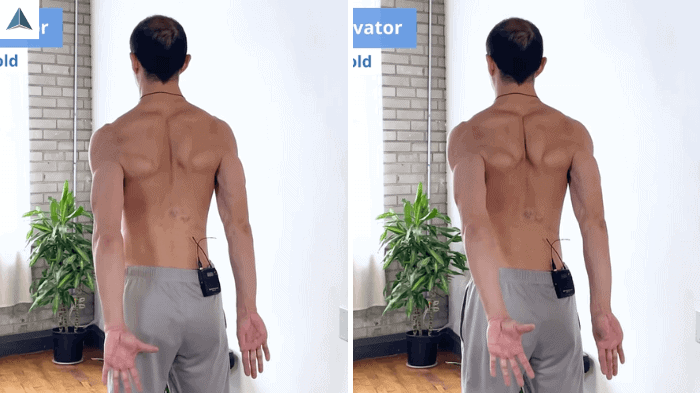
- Start in a slumped posture with chin poked forward and spine rounded.
- Pull your chin in, straighten your spine, and lift your hands behind you. Internally rotate your shoulders so the backs of your hands face each other and palms face out.
- Posteriorly tilt your shoulder blades (suck the bottom edge of the scapula toward your spine) while simultaneously lifting your hands up away from the floor.
- Slowly return your arms to your sides, palms facing your thighs, keeping tension in the scapular muscles.
- Hold each rep for 10 seconds, focusing on maintaining posterior tilt.
Benefits:
- Activates and strengthens the serratus anterior.
- Teaches posterior tilt awareness to prevent shoulder hiking.
- Improves scapular stability for plank and side plank exercises.
- Helps improve shoulder positioning, which may reduce irritation in these areas.
Exercise 2: Chair Shrugs
Chair shrugs strengthen the scapular stabilizers and the long head of the triceps in a closed-chain position, mimicking the mechanics of planks. Closed-chain exercises are ideal because your hands are fixed while your body moves on top, training the muscles to stabilize the shoulder under load.

- Sit on the edge of a sturdy chair or stool and place your hands on the seat pan. Maintain a neutral spine, not hyperextended.
- Slide your butt off the edge and slowly lower yourself, keeping elbows straight. Shoulders will hike toward your ears naturally.
- Press up through your hands, pinching shoulder blades together, keeping a posterior tilt, and hold at the top for 5 seconds.
- Slowly lower yourself again, maintaining elbow extension.
- Repeat 5 reps per set, 2 sets. Focus on quality over speed.
Benefits:
- Strengthens scapular retractors: rhomboids and lower trapezius.
- Activates the long head of the triceps and contributes to shoulder stability during weight-bearing positions.
- Mimics the shoulder demands of a plank in a safe, controlled environment.
- Reinforces proper shoulder posture during weight-bearing exercises.
Exercise 3: Scapular Push-Up
The scapular push-up builds awareness and control of shoulder blade positioning under load, crucial for reducing plank exercise shoulder pain. This exercise focuses on controlling scapular protraction and retraction without stressing the elbow joint.

- Start in a push-up position from your knees, hands slightly wider than shoulder-width.
- Keep elbows straight and shoulders down away from your ears.
- Allow your body to “fall” slightly between your hands while maintaining scapular control.
- Press up slowly, keeping elbows straight, shoulders down, and shoulder blades engaged.
- Perform 6–10 reps per set, 2 sets, stopping if you lose form.
Benefits:
- Improves scapular control during planks and side planks.
- Trains awareness of neutral shoulder blade position.
- Strengthens triceps and upper back stabilizers.
- Reduces front and side shoulder pain caused by poor form.
Why These Exercises Actually Work
Plank-related shoulder pain often happens because the muscles around your shoulder aren’t helping enough to keep your shoulder in a good position. If those muscles aren’t activating well, it can be hard to hold the shoulders steady, and that’s when irritation or discomfort shows up.
The exercises in this routine – the slumpy serratus activator, chair shrugs, and scapular push-ups – help these muscles work together. They train your shoulders to stay down, keep your shoulder blades engaged, and support your body weight more comfortably during planks and side planks.
The slumpy serratus activator wakes up the often “sleepy” serratus anterior and helps you feel and control your shoulder blades. Chair shrugs and scapular push-ups then train those muscles while your hands or arms are supporting your body, teaching your shoulders to stay stable during weight-bearing exercises like planks.
In short, these exercises don’t just make the muscles stronger – they help you control your shoulders so you can hold plank positions more comfortably.
Routine Summary
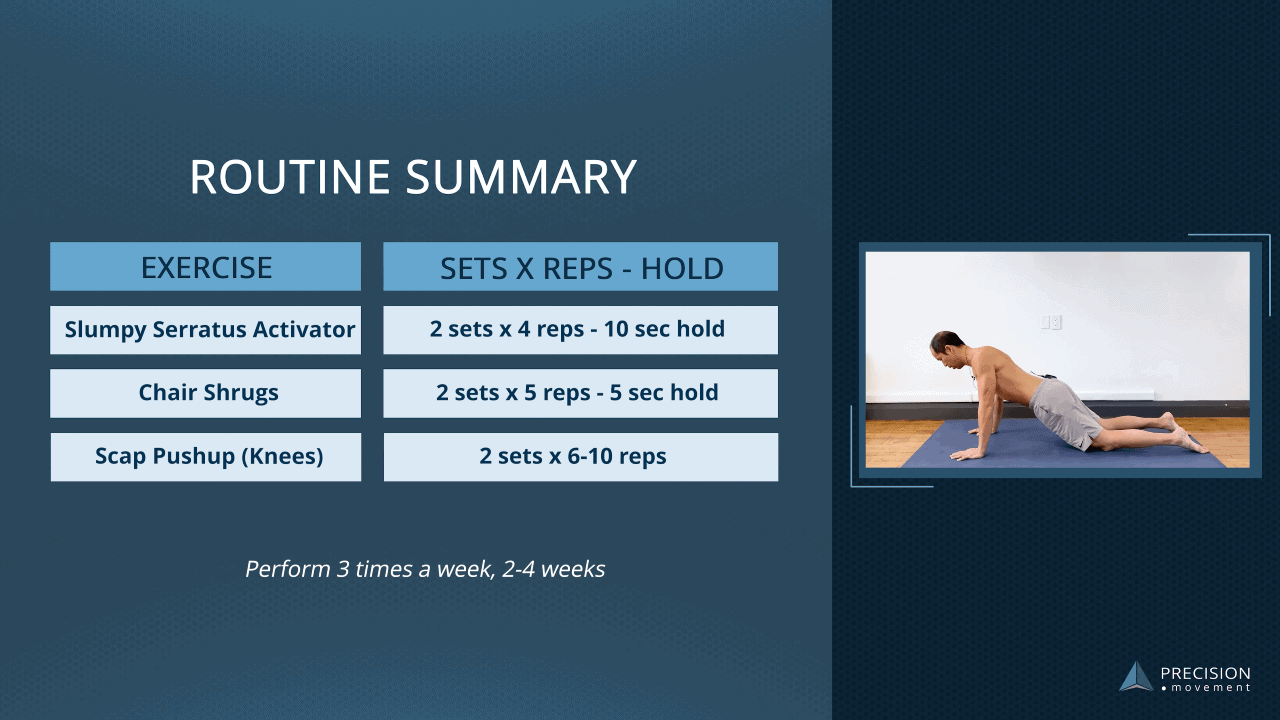
Perform this routine three times per week:
- Slumpy Serratus Activator: 2 sets × 4 reps, hold 10 seconds.
- Chair Shrugs: 2 sets × 5 reps, hold 5 seconds at top.
- Scapular Push-Up: 2 sets × 6–10 reps.
Perform this routine three times per week. Many people begin to feel improvement in comfort and stability over the following weeks.
Plank & Side Plank Technique Tips
- Keep shoulders down, away from your ears.
- Engage rhomboids, lower traps, lats, and triceps long head.
- Push yourself away from the floor instead of sinking into your arms.
- Maintain scapular neutral; don’t fully protract the shoulder blades.
- Remember to breathe while holding the plank.
Once you’ve mastered this routine, you can safely integrate full plank variations and side planks into your workouts without shoulder pain. For more targeted programs, check out our ROM Coach app, which includes exercises to strengthen the core, improve posture, and reduce shoulder irritation in all your favorite movements.
Key Takeaways
- Shoulder pain during planks is often related to poor shoulder positioning and insufficient stabilizer strength or activation.
- Serratus anterior, rhomboids, lower traps, lats, and long head of triceps are critical.
- Slumpy serratus activator, chair shrugs, and scapular push-ups target these muscles.
- Perform 3x/week with proper technique for 2–4 weeks to feel results.
- Keep shoulders down, scapula neutral, and push away from the floor during planks.