

When knee pain shows up, most people are told the same thing: stretch more.
Stretch your quads. Stretch your hamstrings. Stretch your IT band.
And if your knees feel worse afterward? You’re told to stretch harder.
That advice is everywhere – and it’s one of the biggest reasons knee pain sticks around.
In this article, I’m going to walk you through the knee pain exercises to avoid, explain why those popular stretches often backfire, and show you the best exercises for knee pain that actually restore control, stability, and confidence in your knees.
If your knees feel achy after running, tennis, workouts, or even the next morning when you get out of bed, this is for you.
Why Knee Pain Gets Worse When You “Just Stretch”
Stretching feels productive. It feels like you’re doing something helpful.
But here’s the problem:
Most knee pain isn’t caused by a lack of flexibility – it’s caused by a lack of control.
When you aggressively stretch:
- You increase passive range of motion
- Without increasing active control
- Which creates joint instability
Instability is a huge driver of knee pain.
Research consistently shows that joints rely on muscle activation and neuromuscular control to stay healthy – not just flexibility alone [1]. When muscles can’t control motion, ligaments and cartilage take the hit.
That’s why many of the worst knee exercises are actually the most popular stretches.
Let’s break them down – and fix them.

Knee Pain Exercise to Avoid #1: Quad Stretches
This includes:
- Standing heel-to-butt quad stretch
- Side-lying quad stretch
- Couch stretch (the biggest offender)
Why Quad Stretches Can Hurt Your Knees
Quad stretches load the knee joint heavily – especially the couch stretch.
You’re:
- Driving pressure directly into the patella
- Tensioning the quadriceps and patellar tendon
- Often compressing already-irritated cartilage or meniscus
If you have knee pain, that’s a recipe for irritation – not relief.
The couch stretch is particularly rough because you’re:
- Putting bodyweight through the knee
- While simultaneously reefing on the quad
- With zero active control
That’s why this ends up on every list of exercises that hurt knees.
What to Do Instead: ASMR for the Quads
Instead of passive stretching, we want active lengthening with control.
This Active Self-Myofascial Release technique releases quad tension while activating the hamstrings – exactly what the knee needs.
Exercise: ASMR Quads
This isn’t just foam rolling. You’re actively moving through range while your muscles stay engaged, restoring control instead of yanking on tissue.
Rolling the quad while bringing your heel to your butt creates an active stretch: your hamstrings contract to control the motion, your quads are gently released, and your patella and tendon experience less compression.
This strengthens the coordination of the surrounding muscles while increasing comfort through active motion.

- Get a foam roller and lie face down
- Place the roller just above the knee
- Shift as much weight onto it as you can without tensing up
- Stay relaxed and breathe
- Slowly bend your knee, bringing your heel toward your butt
- Roll gradually up the quad as you move
- Rotate slightly to hit inside, middle, and outside quad fibers
- Work all the way up toward the hip
Why It Works
- Actively stretches the quads instead of forcing them
- Activates the hamstrings to restore balance
- Improves active range of motion
- Reduces joint irritation instead of increasing it
- Builds stability, not slack

Knee Pain Exercise to Avoid #2: Hamstring Stretches
Common versions include:
- Lying hamstring stretch with a strap
- Foot-on-chair hamstring stretch
- Reaching forward into gravity-assisted stretch
Why Hamstring Stretching Can Backfire
Hamstring stretches load the knee in full extension.
If you:
- Have cartilage or meniscus irritation
- Or tend toward knee hyperextension
…you’re stressing ligaments that are supposed to be your last line of defense.
Overstretching ligaments creates laxity – and laxity equals instability.
That’s why aggressive hamstring stretching often ends up on the list of worst knee exercises for people in pain.
What to Do Instead: Hamstring End-Range Expansion
We still want length – but we want it earned through strength.
Exercise: Hamstring ERE
By lifting the foot and holding while engaging the quads and hip flexors, then pressing into the stool isometrically, you train active control at end-range knee extension.
Both the quads and hamstrings contract in a coordinated manner, which strengthens muscles around the joint and improves stability.
This controlled activation reduces stress on ligaments and prevents hyperextension injuries.

- Stand tall with good posture
- Place one foot on a low stool or chair
- Align hips and spine—don’t slouch
Phase 1: Active Lift
- Lift your foot off the stool
- Hold for 10 seconds
- Breathe normally
- Feel quads and hip flexors working
Phase 2: Hamstring Isometric
- Place foot back down
- Press foot into the stool
- Think about bending the knee without moving it
- Hold for 10 seconds
Phase 3: Repeat Lift
- Lift foot again
- Hold 10 seconds
- Lower and relax
Why It Works
- Builds strength at end-range instead of stressing ligaments
- Improves active knee extension control
- Reduces hyperextension tendencies
- Enhances joint stability where it matters most

Knee Pain Exercise to Avoid #3: IT Band Stretches
These usually look like:
- Pulling the leg across the body
- Leaning into a wall to “stretch” the outside thigh
Why IT Band Stretching Misses the Mark
Here’s the truth:
The IT band doesn’t stretch well.
What does stretch easily?
- Glute medius
- Glute minimus
And those are the muscles you actually need working.
Most lateral knee pain isn’t from a “tight IT band” – it’s from an overworked TFL compensating for weak lateral glutes.
Stretching the outside hip often makes the problem worse.
What to Do Instead: Release + Lateral Hip Activation
First, we calm things down.
Then, we restore the right muscles.
Exercise 1: ASMR ITB
This active rolling reduces tension in the IT band and TFL while keeping muscles engaged, promoting neuromuscular relaxation. The gentle bend of the knee activates the hamstrings and glutes slightly, which encourages proper recruitment and decreases compensatory overactivity of the TFL.

- Lie on your side with a foam roller
- Start just above the knee
- Roll up toward the hip
- As you roll, bend your knee and bring heel toward your butt
- Stay relaxed
Exercise 2: Side-Lying Hip Abduction
This exercise activates the lateral glutes to take over the work that the TFL has been doing. Pressing the heel into the wall recruits the glute medius and minimus, allowing the TFL to relax. Sliding the leg up and down with controlled tension improves hip-knee coordination and stabilizes lateral knee mechanics, reducing IT band-related pain.
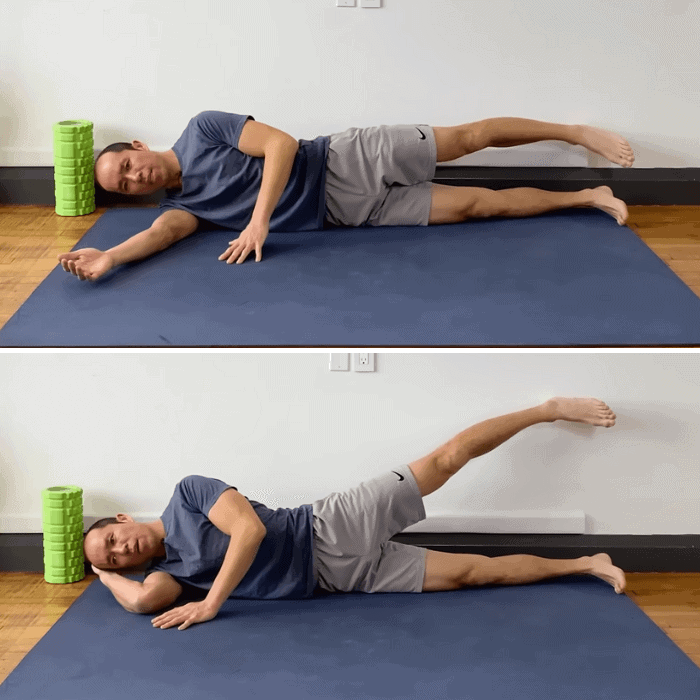
- Lie on your side about 1-2 inches from a wall
- Keep body straight
- Press your heel gently into the wall
- Maintain pressure to activate glute max
- Slowly slide the leg upward
- Hold 5 seconds
- Slide back down with control
Why It Works
- Activates glute medius and minimus
- Reduces TFL dominance
- Improves lateral hip stability
- Decreases lateral knee stress
Routine Summary and Next Steps

Consistency matters. To restore control, reduce irritation, and rebuild confidence in your knees, follow this simple routine. Each exercise combines active release and activation to replace common knee pain exercises to avoid.
This routine is designed to be completed 3 days per week in 15-20 minutes. Focus on quality, slow movements, and controlled activation over quantity or maximal range:
- Active Quad ASMR: 1-2 min per side
- Hamstring ERE: 2-4 reps per side
- IT Band & TFL Release: 1 min per side
- Side-Lying Hip Abduction: 2 × 4-6 reps (5-sec holds)
For a step-by-step progression addressing all root causes of knee pain – from hips to ankles – start the Knee Pain Solution inside the ROM Coach app. It guides you from A to Z, so you’re never guessing what to do next.
Also check out:
- 4 Tibial Rotation Exercises to Fix Knee Pain at Home
- How to Prevent Knee Pain: 5 Essential Exercises for Healthy Joints
Key Takeaways
- Most knee pain exercises to avoid are aggressive stretches
- Passive flexibility without control creates instability
- Quad, hamstring, and IT band stretches often worsen symptoms
- Active range of motion restores joint stability
- These are some of the best exercises for knee pain long-term